


Dimension Modelling and Analysis: Latino Car Garage
- Adewoye Saheed Damilola
- Nov 10, 2024
- 2 min read


Access the full notebook here
Project Overview
For this project, I designed a data model and conducted analysis for a fictional auto service center, Latino Car Garage. I used MySQL to build the data model based on the garage's receipt data and connected it locally to Jupyter Notebook, allowing me to perform in-depth analysis on real-world metrics like customer billing, vehicle servicing, and parts inventory.
The Model Design
I created a star schema model, with an Invoice Fact Table at its center, and surrounding dimension tables to provide detailed context for each transaction. Here’s an overview of the structure:
Invoice Fact Table: The main table includes key metrics that track each transaction, such as:
Invoice ID, Date, Due Date: To identify each transaction and track payment schedules.
Customer ID, Vehicle ID, Service ID, Part ID: Foreign keys linking to the related dimension tables.
Quantity, Hours, Amount, Tax Rate, Total Labor, Total Parts, Sales Tax, Total Amount: Financial details to understand the cost breakdown of each job.
Customer Dimension: Tracks customer details to personalize service records, including:
Customer ID, Name, Address, Phone Number, Email
Vehicle Dimension: Stores vehicle details for efficient record-keeping and trend analysis:
Vehicle ID, Make, Model, Year, Color, VIN, Registration Number, Mileage
Service DimensionHolds the details of each service offered, including:
Service ID, Service Description, Hourly Rate
Part DimensionContains information on parts used, with:
Part ID, Part Name, Unit Price
Date Dimension: A versatile table to slice data by time periods, storing:
Date ID, Full Date, Year, Month, Day, Weekday

Star Schema ERD
Connecting to Jupyter Notebook for Analysis
With the model set up in MySQL, I connected it to Jupyter Notebook using the '%sql' magic command for data analysis. This setup allowed me to run SQL queries and perform advanced calculations directly in the notebook, generating insights into things like:
Customer spending and behaviour
Identifying the most common vehicle makes and models brought in for service
Identifying any trends in service requirements based on vehicle age
Total revenue generated from each job
etc..

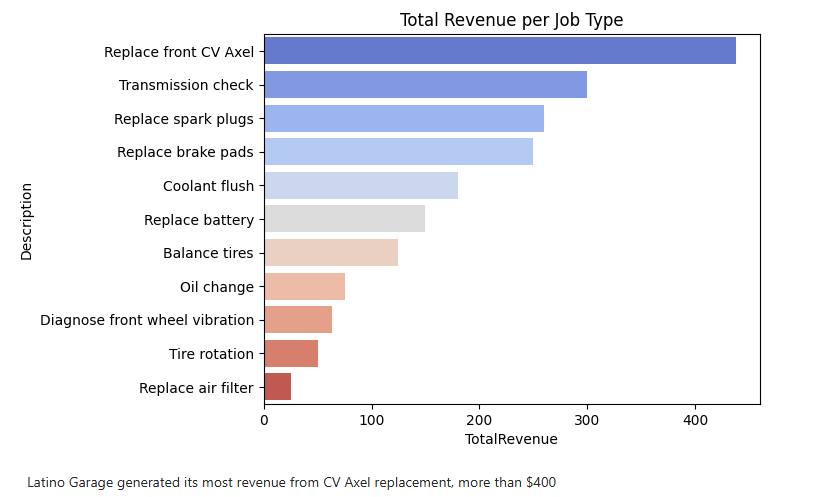
from the Author's notebook
Conclusion
This project provided a practical, hands-on approach to database design and analytics, combining data modeling with SQL and Jupyter Notebook for actionable insights. By organizing the data in a star schema, I made it easy to query and analyze, supporting Latino Car Garage in understanding customer needs, managing parts, and optimizing service offerings.



Comments